
We talk a lot about amps, metals, and techniques in welding. But the most critical interface between you and your work isn’t the torch or the rod—it’s your welding gloves. Think of them not as mere accessories, but as sophisticated, miniaturized personal protective systems. The difference between a painful spark burn and a flawless bead often boils down to the unsung engineering of the glove on your hand. Let’s pull back the curtain on what really makes a great pair of welding gloves tick, moving beyond “leather” and “heat resistant” to understand the why.
The Three-Headed Beast: Heat Transfer in Welding

To build a great shield, you first need to understand the attack. In welding, heat comes at your hands in three main ways, and your welding gloves must handle all of them.
- Conductive Heat: This is direct contact heat. Picking up a hot metal workpiece, adjusting a warm torch handle, or the moment a molten droplet splashes onto the glove. This requires a material with high thermal resistance that doesn’t instantly transfer that energy to your skin.
- Radiant Heat: The intense glow of the welding arc or a cooling weld pool bombards your hands with infrared radiation, like a tiny sun. This is why gloves are often reflective or made of dense, insulating materials that reflect and absorb this radiant energy before it cooks your hands.
- Convective Heat & Sparks: The rising plume of superheated air, along with a spray of tiny, glowing spatter, flies around the work area. This demands a sealed or tightly woven construction, especially at the seams and cuffs, to prevent these hot particles from finding a way inside.
A glove that only addresses one or two of these is a liability. The best gloves are designed as a holistic defense system. More Comprehensive Protective Equipment for Welders
Material Matters: More Than Just “Leather”
When we say “leather,” it’s a starting point, not a finish line. The type, treatment, and construction define performance.
- Cowhide: The workhorse. Dense, durable, and naturally heat resistant. Its thickness, like the 1.3 mm soft natural cowhide used in our Unisex Cowhide Leather Welding Gloves, offers a fantastic balance. It’s thick enough to block radiant heat and resist abrasion from grinding, yet when treated properly, it retains enough flexibility for a good grip. This is the leather you want for general MIG, stick, and cutting work where dexterity and bulk protection are both needed.
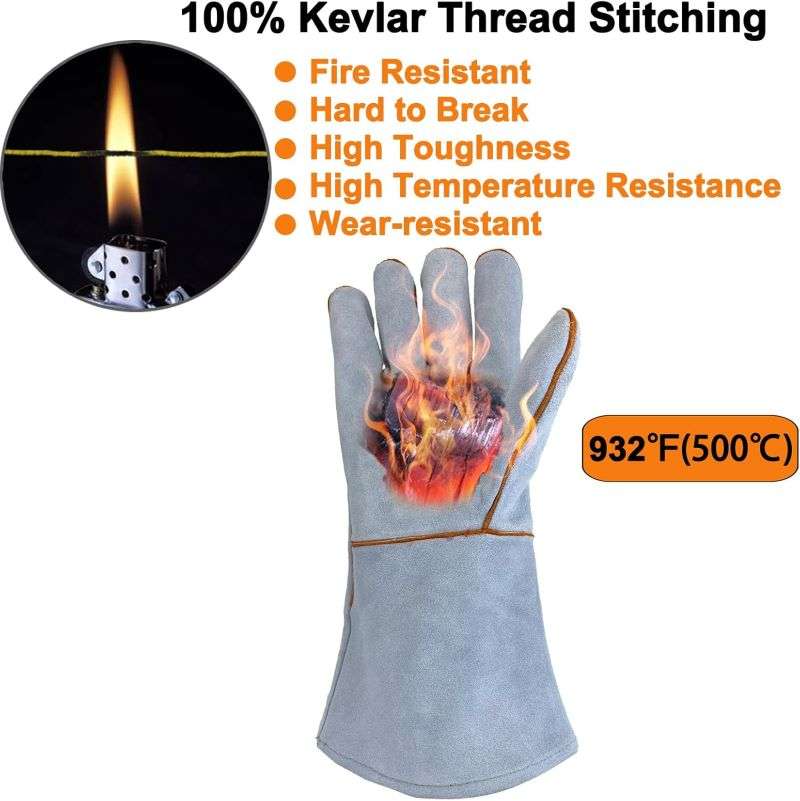
- The Double-Layer Defense: For extreme conductive heat, a single layer has limits. This is where a construction like our Double-Layer Cowhide High-Temperature Protective Gloves changes the game. Two layers of genuine cowhide, often with an air gap or cotton lining between them, massively increase the thermal pathway. Heat must travel through the first leather layer, then across the insulated gap, then through the second layer before reaching you. This is why they can be guaranteed to withstand temperatures up to a staggering 932°F—they’re essentially a compact thermal fortress for your hands.
- The Lining: Your Climate Control: The inner layer isn’t just for comfort. A 100% soft insulated cotton lining, present in both our Unisex and Double-Layer gloves, is a smart piece of the puzzle. It wicks sweat, keeping you cooler, adds a soft barrier against conductive heat, and provides breathability. In cold environments, that same trapped air insulates against the cold. It’s a year-round comfort layer.
The Anatomy of a Safe Glove: Stitching, Cuffs, and Fit
The materials can be perfect, but weak points will fail first.
- The Seams: This is where many budget gloves disintegrate. High-heat areas demand flame-retardant thread like Kevlar. Regular thread can melt or burn, popping seams at the worst moment. Reinforced stitching in high-wear areas like the thumb crotch is a sign of quality.
- The Cuff: Your Wrist’s Best Friend: A short cuff is an invitation for sparks. For processes like stick welding that throw a lot of spatter, or when working overhead, a long cuff is non-negotiable. Our top-tier gloves feature 14-inch designs that protect the forearms from grinding debris, sparks, and radiant heat. It’s a simple extension that prevents a world of painful burns.
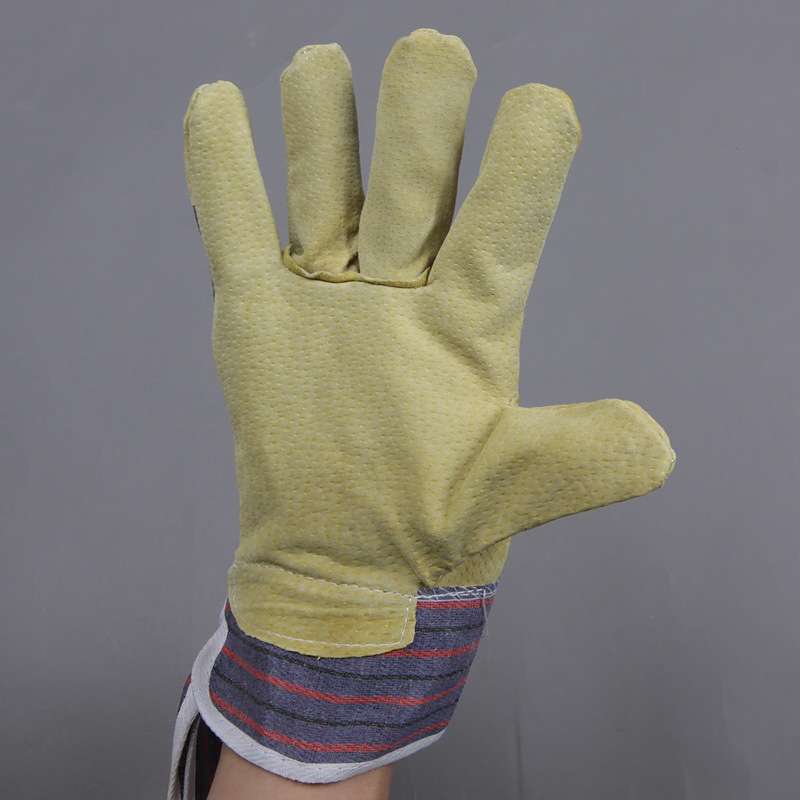
- Fit & Dexterity: A baggy glove is a dangerous glove. It snags, reduces feel, and can trap spatter inside. A good fit, like the “one-size-fits-most” design of our Yellow Protective Leather Welding Gloves, should allow you to make a fist and pick up small tools without excessive bulk. Their bright color is a bonus safety feature for visibility on a busy job site.
Matching the Glove to the Arc: A Quick Guide
Not all welding is the same, and your gloves should match your process.
- MIG & Stick Welding: These are the “hot and heavy” processes. You need robust protection from high spatter and radiant heat. The Unisex Cowhide Leather gloves or the Double-Layer Cowhide gloves are ideal here. Their durability and full coverage stand up to the punishment.
- TIG Welding: Here, precision is king. You need finer dexterity to handle a thin filler rod. While still needing heat protection from the arc, you might opt for a lighter, more flexible glove. The dexterity of a well-broken-in cowhide glove, like our unisex pair, often provides the perfect balance for many TIG welders who also do other work.
- The All-Rounder & Hobbyist: For the DIYer who welds a little, grinds a little, and maybe tends the backyard BBQ, versatility is key. Our Yellow Protective Leather Welding Gloves are the affordable, reliable entry point. They cover the wrists, offer solid basic protection for arc/MIG/TIG, and are good for BBQ or automotive work, making them a spectacular value.
The Takeaway: It’s an Investment in Your Craft and Skin
Choosing the right welding gloves is a technical decision. It’s about understanding the threats your specific work creates and selecting the armor designed to counter them. It’s the difference between fearing the heat and commanding it.
Whether you need the extreme, double-layered fortress for furnace-adjacent work, the balanced and versatile protection of trusted cowhide, or the visible, budget-friendly utility of a bright yellow pair, the right tool transforms the experience. Don’t let your hands be the weak link in an otherwise perfect weld.
Ready to equip yourself with intelligently engineered protection? Explore our range of professional welding gloves, from heavy-duty to high-dexterity, and find your perfect match for the heat.