
If you run a shared workshop or a small fabrication shop, small confusion adds up fast. Tools get mixed, tasks overlap, and the wrong glove on the wrong job becomes a hazard. A simple fix that works better than memos? Welding gloves are used as a color-coded, task-specific system. This is a practical guide that teaches you how to design and implement welding glove color protocols to reduce errors, speed up handover, and ensure people’s safety.
Why Color-Coding Welding Gloves Helps

People are visual. A bright glove on a peg screams, “This is for X.” That shriek of clarity beats a sticky note that gets ignored. Different tasks present different dangers in various welding processes such as TIG welding, MIG welding, and manual arc welding. Color-coding welding gloves helps operators immediately match protection level with task: heavy-duty gloves for hot handling, lighter gloves for precise work, and visible safety pairs for guest or food-related handling.
It’s low-tech. It’s fast. And it prevents the small slips that lead to burns, ruined parts, or contaminated food when shops double as event spaces.
Pick Your Palette
Start small. Use three or four colors; anything more becomes a management task.
- Red: Hot handling & heavy thermal work. Use long, double-layer welding gloves for tasks with direct contact with red-hot metal or coals.
- Blue: Precision & prep (TIG, fine fitting). Use thinner leather or half-leather gloves where dexterity matters.
- Yellow: General shop & shared tasks. Bright pairs that anyone can grab for light MIG work or moving parts.
- Green: Clean/guest pair for BBQ or demonstrations. These never touch oily metal.
You don’t have to be literal with colors; paint, tape, or colored tags work too. The point is visual immediacy.
Three Steps That Actually Stick

You can pilot this in a day. No committee required.
- Label & locate. Hang color-coded hooks at stations. Attach a laminated card explaining the color’s role. Keep the red rack near heat sources and the blue rack near TIG stations. Visual proximity reduces mistakes.
- Train for 10 minutes. Get everyone together, show the racks, and run a 5-minute roleplay: “You need to lift that hot plate—what color do you grab?” Do it twice. That’s it.
- Enforce by design. Make it awkward to forget: cross-check beforehand, and require the receiving person to confirm glove color out loud. Small verbal habits lock in new behavior.
This is about nudges, not policing.
Rules and Detail Items That Matter
- Never put a “clean” color back into a dirty bin. Discipline on swaps is the whole point.
- Use long cuffs for red gloves; shorter cuffs are fine for blue. Match cuff length to exposure risk.
- If the welding gloves are heavily contaminated, replace or discard them. Do not force them to be cleaned in order to make the color recognition system work.
- Keep spares: each color should have at least two pairs per active station.
These pragmatic rules sustain the system when days get busy.
Monitoring and Quick Metrics
You don’t need spreadsheets. Use two simple checks:
- Weekly visual audit: Are gloves on correct hooks? Takes five minutes.
- Incident log: note any glove-related slips. If one station shows repeated wrong-glove use, retrain.
Small data, big signal.
The Social Side: Making It Part of Culture
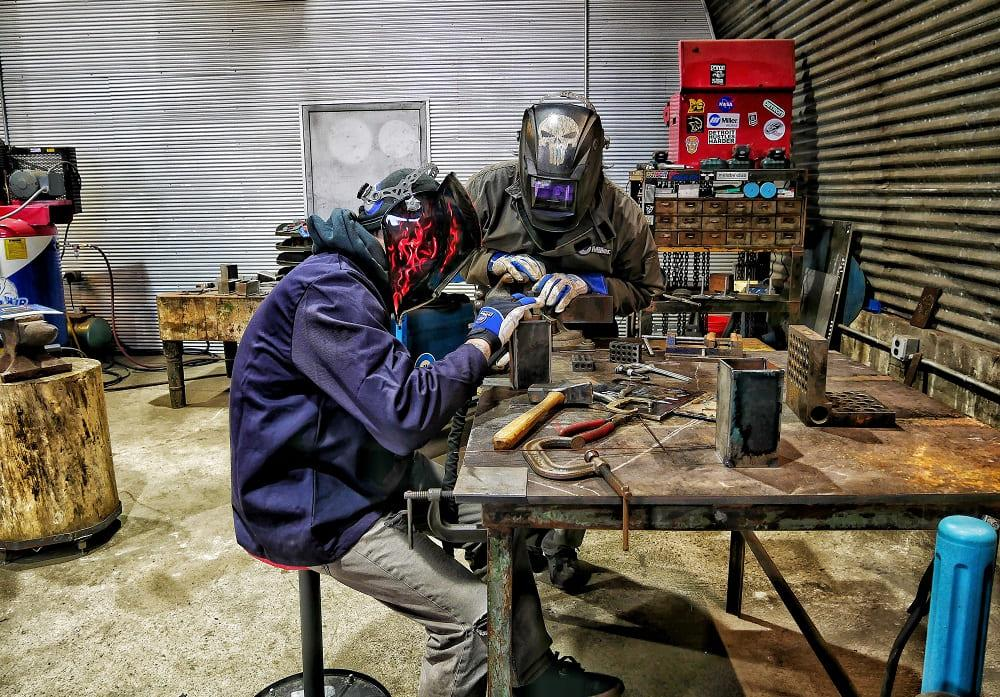
Color-coding works only if people believe in it. Celebrate adherence. When someone catches a wrong glove swap, praise it out loud. Use humor. Presenting a guest with a pair of clean green gloves is like presenting them with “golden gloves.” When hosting a demonstration event, consider turning it into a small ritual. Rituals make the system sticky.
Quick Troubleshooting
- Too many exceptions? Simplify colors.
- People steal the “nice” yellow pair for Shop C? Remind politely and add a visible tag: “Shop only.”
- Gloves vanish? Add a lightweight sign-in for rare, high-value pairs.
Don’t overengineer. Fix the behavioral leak, not the whole system.
Bottom Line: Small Systems Beat Big Policies
A color-coded welding gloves protocol reduces cognitive load and speeds decision-making. It’s visual, cheap, and scales from a two-person shop to a community makerspace. First, prepare three pairs of welding gloves, choose three different colors, hang them on hooks, and then practice for two minutes. You’ll cut tool confusion and, more importantly, lower the small risks that trip up perfectly competent people every day.
Try it for a month. You’ll notice fewer “oops” moments and fewer burned fingers. Explore our welding gloves collection and choose the perfect fit for your needs.